Remembering Our Newfoundland Mercy Story 19:
Sr Mary Benedicta Fitzgibbons

Minnie Fitzgibbons was born in St. John’s on February 2, 1869, daughter of Margaret and Edmund Fitzgibbon. She was one of the first to study at St. Clair’s Boarding School which had opened at the Mercy Convent site in 1861. During her years there, she studied piano under the direction of one of the school’s teachers, Professor Hancock. She was among the first to be enrolled at St. Bride’s Boarding School when it opened in 1884.

After the completion of her studies at St. Brides, Minnie entered the Sisters of Mercy, and at her reception into the novitiate received the name Sister Mary Benedicta. She was professed on December 27, 1887. During her years at St. Bride’s Sister M. Benedicta’s musical talent was developed under the direction of the highly skilled Sister M. Xaverius Dowsley, and she herself became an accomplished musician. She wrote the music for one of Archbishop Howley’s poems, Dear Old Southside Hills.
Sister M. Benedicta was one of the last Sisters to teach at St. Peter’s School, formerly Fishermen’s Hall located on the corner of Queen Street and George Street. It operated as a school from 1881 until 1903, when it was replaced by St. Vincent’s School on the “Parade Grounds,” where The Rooms is situated today. Over its twenty- two- year history many of the sisters from Mercy Convent taught at St. Peter’s.

After Amalgamation in 1916, Sister M. Benedicta was named the first novice mistress for the new Congregation of the Sisters of Mercy of Newfoundland. In 1922 at the completion of her six-year term at the Novitiate, she went as superior of the founding community of St. Joseph’s Convent in the Hoylestown area of St. John’s. She taught music in St. Joseph’s School, providing a comprehensive music program for the students as well as taking responsibility for parish liturgies.

Between 1937 and 1949 Sister M. Benedicta held the office of local superior both at Mercy Convent and at St. Clare’s Convent. While at St. Clare’s she and her community, with the help of generous benefactors, created a fund called St. Joseph’s Burse which allowed St. Clare’s to provide free accommodation and care to needy pregnant mothers and their babies in the absence of government remuneration. This fund continued until the advent of National Health Insurance in 1958.

In 1949 Sister M. Benedicta returned to Mercy Convent where she resumed her teaching of music until failing health necessitated retirement from active ministry. She died on July 15,1959 at the age of 90 years and is buried in Belvedere cemetery.

Minnie Fitzgibbons nació en St. John’s el 2 de febrero de 1869, hija de Margaret y Edmund Fitzgibbon. Fue una de las primeras en estudiar en el internado de St. Clair, que había abierto sus puertas en el convento de la Misericordia en 1861. Durante sus años allí, estudió piano bajo la dirección de uno de los profesores de la escuela, el profesor Hancock. Fue una de las primeras en matricularse en el internado St. Bride’s cuando se inauguró en 1884.

Tras finalizar sus estudios en St. Brides, Minnie ingresó en las Hermanas de la Misericordia, y en su recepción en el noviciado recibió el nombre de Hermana Mary Benedicta. Profesó el 27 de diciembre de 1887. Durante sus años en St. Bride, el talento musical de la Hermana M. Benedicta se desarrolló bajo la dirección de la muy hábil Hermana M. Xaverius Dowsley, y ella misma se convirtió en una música consumada. Escribió la música para uno de los poemas del Arzobispo Howley, Dear Old Southside Hills.

La Hermana M. Benedicta fue una de las últimas Hermanas que enseñó en la Escuela de San Pedro, antiguamente Fishermen’s Hall, situada en la esquina de Queen Street y George Street. Funcionó como escuela desde 1881 hasta 1903, cuando fue sustituida por la St. Vincent’s School en el «Parade Grounds», donde hoy se encuentra The Rooms. A lo largo de sus veintidós años de historia, muchas de las hermanas del Convento de la Misericordia enseñaron en St.

Después de la Amalgamación en 1916, Sor M. Benedicta fue nombrada primera maestra de novicias de la nueva Congregación de las Hermanas de la Misericordia de Terranova. En 1922, al término de su mandato de seis años en el noviciado, fue superiora de la comunidad fundadora del convento de San José, en la zona de Hoylestown, en San Juan. Joseph’s School, donde impartió un amplio programa musical a los alumnos, además de responsabilizarse de las liturgias parroquiales.

Entre 1937 y 1949 la Hermana M. Benedicta ocupó el cargo de superiora local tanto en el Convento de la Misericordia como en el Convento de Santa Clara. Mientras estuvo en St. Clare’s, ella y su comunidad, con la ayuda de generosos benefactores, crearon un fondo llamado St. Joseph’s Burse, que permitía a St. Clare’s proporcionar alojamiento y cuidados gratuitos a madres embarazadas necesitadas y a sus bebés en ausencia de remuneración gubernamental. Este fondo continuó hasta la llegada del Seguro Nacional de Salud en 1958.

En 1949, la Hna. M. Benedicta regresó al Convento de la Misericordia, donde reanudó la enseñanza de la música hasta que, por problemas de salud, tuvo que retirarse del ministerio activo. Murió el 15 de julio de 1959 a la edad de 90 años y está enterrada en el cementerio de Belvedere.

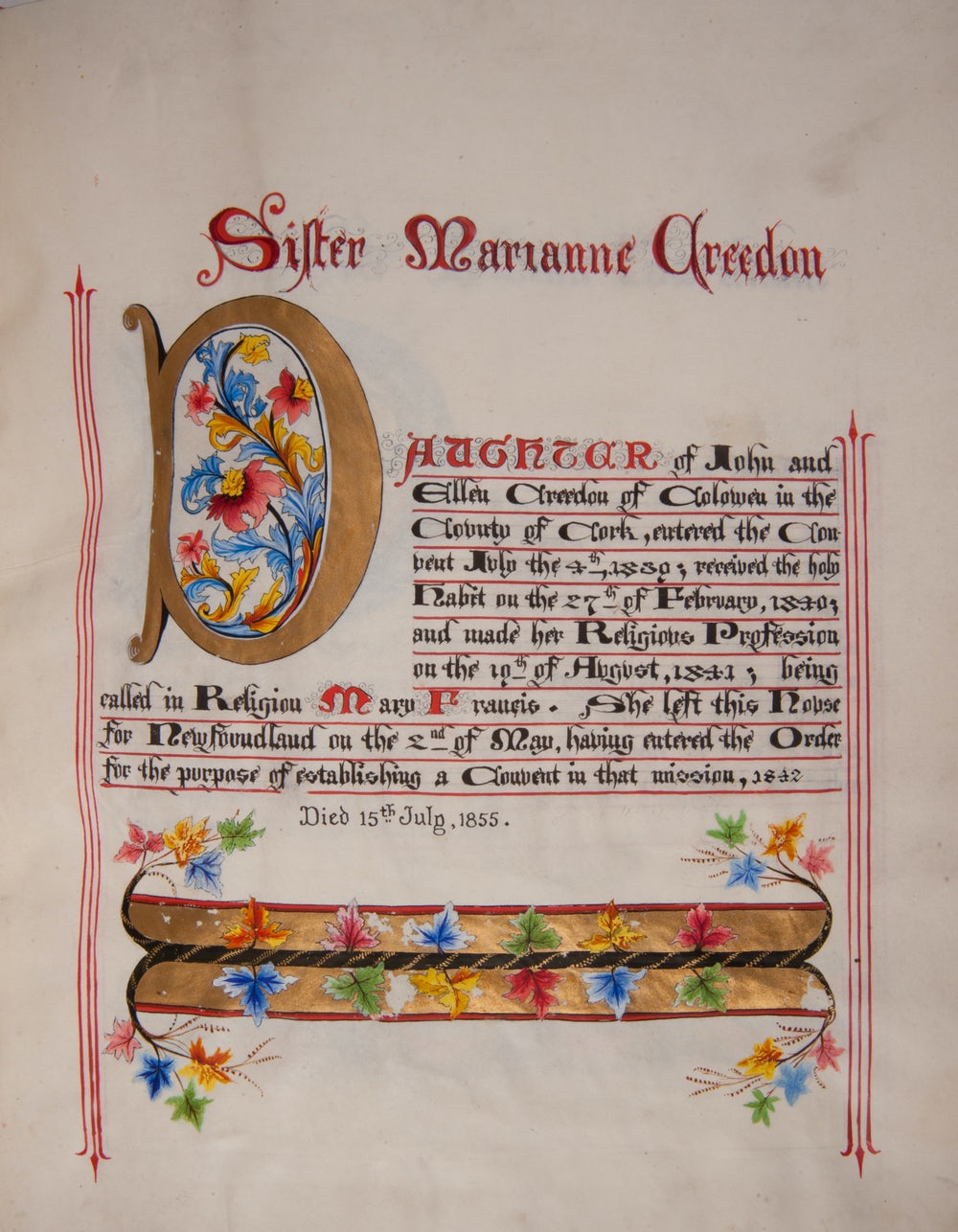
Anniversary of death of Sister M. Francis Creedon

On July 15, we remember with gratitude our revered Newfoundland Mercy foundress, Sister M. Francis Creedon. For thirteen years under the most difficult and demanding circumstances she led the Mercy community in St. John’s.

She and her few companions ministered in the school she had opened in 1843 and cared for the sick in their homes and at St. John’s Hospital, even during the most virulent epidemics that occurred so frequently in St. John’s in those days. Just a year before her death she opened Immaculate Conception Orphanage at Mercy Convent to care for children orphaned by these epidemics.
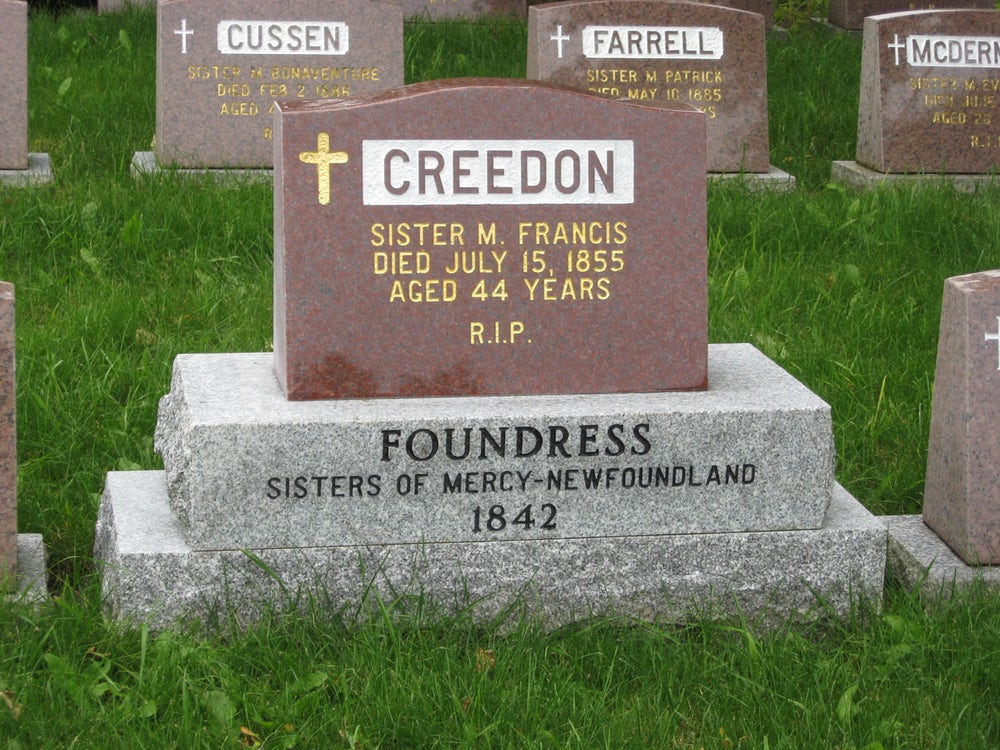
By the Spring of 1855 the many responsibilities and demands of the small community, the school, the orphanage and visitation of the sick began to take a toll on Sister M. Francis’ health. But ever the steadfast woman, she went to the home of a dying person, bringing comfort and care less than two weeks before her death.

Sister M. Francis died on July 15, 1855. She was 44 years old and had lived as a Sister of Mercy in Newfoundland for thirteen years. A notation in Bishop Mullock’s diary reads thus:

                              Mrs. Creedon, Superioress of the Convent of Mercy died this
                              morning, a victim of overwork for the poor and sick    

Sister M. Francis left behind a small community of four sisters, the oldest being 27 years of age and one of them a novice. Francis’ spirit lived on in the fledgling community and their Mercy ministry continued to bring hope and compassion to all around them.

El 15 de julio recordamos con gratitud a nuestra venerada fundadora de la Misericordia de Terranova, la Hermana M. Francis Creedon. Durante trece años, en las circunstancias más difíciles y exigentes, dirigió la comunidad de la Misericordia en San Juan.

Ella y sus pocas compañeras ejercieron su ministerio en la escuela que había abierto en 1843 y atendieron a los enfermos en sus casas y en el Hospital de San Juan, incluso durante las epidemias más virulentas que se daban con tanta frecuencia en San Juan en aquellos días. Justo un año antes de su muerte abrió el Orfanato de la Inmaculada Concepción en el Convento de la Misericordia para atender a los niños huérfanos a causa de estas epidemias.
En la primavera de 1855, las muchas responsabilidades y exigencias de la pequeña comunidad, la escuela, el orfanato y las visitas a los enfermos empezaron a hacer mella en la salud de la hermana M. Francis. Sin embargo, como mujer inquebrantable que era, acudió al hogar de un moribundo, llevándole consuelo y cuidados menos de dos semanas antes de su muerte.

La hermana M. Francis murió el 15 de julio de 1855. Tenía 44 años y había vivido como Hermana de la Misericordia en Terranova durante trece años. Una anotación en el diario del Obispo Mullock dice así:

La Sra. Creedon, Superiora del Convento de la Misericordia murió esta mañana.
                                víctima del exceso de trabajo con los pobres y los enfermos.

La hermana M. Francis dejó tras de sí una pequeña comunidad de cuatro hermanas, la mayor de 27 años y una de ellas novicia. El espíritu de Francisco pervivió en la incipiente comunidad y su ministerio de la Misericordia siguió llevando esperanza y compasión a todos los que les rodeaban.


Feast of Our Lady of Mount Carmel – July 16

Today, July 16, is a special day for many Sisters of Mercy of Newfoundland. We gather to celebrate in prayer and reflection.

Mount Carmel

May God’s Spirit be with us as we take these moments to think about what this day means to us. Sr. Francis Creedon, foundress of the first Mercy Convent beyond Ireland and England, died on July 15, 1855, nearly 170 years ago. We remember her and all Sisters of Mercy who followed her, the young women who came from Ireland to join the Sisters of Mercy, as well as all those who came after her. We remember them and this day…

Download the prayer service here

Hymn: “Here I Come to You” by Briege O’Hare OSC and Marie Cox, RSM, from the album ‘Woman’s Song of God’

Hoy, 16 de julio, es una fecha especial en el calendario de muchas Hermanas de la Misericordia de Terranova. Nos reunimos para celebrar en oración y reflexión.

Que el Espíritu de Dios nos acompañe mientras tomamos estos momentos para pensar en lo que este día significa para nosotras. Sor Francis Creedon, fundadora del primer Convento de la Misericordia más allá de Irlanda e Inglaterra, murió el 15 de julio de 1855, hace casi 170 años. La recordamos a ella y a todas las Hermanas de la Misericordia que la siguieron, a las jóvenes que vinieron de Irlanda, así como a todas las que vinieron después de ella. Las recordamos a ellas y a este día.

Descargue aquí el servicio de oración

Unknown Soldier Laid to Rest in St. John’s

A granite burial chamber that has become a tomb of the unknown soldier on July 1 was lowered into place at the Newfoundland National War Memorial in St. John’s in early April. On Saturday, May 25th the remains of a Royal Newfoundland Regiment soldier who died in northern France during the First World War was returned to Newfoundland and Labrador.

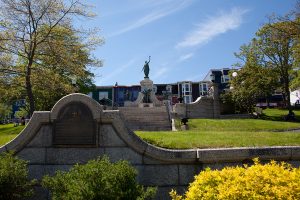
View of the National War Memorial on Water Street St John’s

A lying-in-state took place at Confederation Building from June 28-30 to allow members of the public to pay their respects. On July 1, large crowds gathered in downtown St. John’s for the annual Memorial Day remembrance service and to mark the centennial anniversary of the Newfoundland National War Memorial. As part of the July 1 ceremony, meanwhile, the soldier’s remains were re-interred inside a newly constructed granite burial chamber at the base of the 100-year-old monument.

It is just the second such tomb in Canada, with the National War Memorial in Ottawa adding a tomb of the unknowns nearly a quarter-century ago. It’s essential that the identity of the soldier remains unknown because he will symbolically represent all Newfoundlanders and Labradorians from all branches of service who have no known grave.

Newfoundland was a self-governing British Dominion during the First World War, and more than 12,000 Newfoundlanders served in military or support services during the conflict. More than 1,700 lost their lives during the war, and some 800 of those who died have no known grave. Roughly 600 of those unknown graves are located in France and Belgium, according to the Commonwealth War Graves Commission, and are marked by headstones with the wording “Known Unto God.”

The monument is built of marble, with bronze statuary and iron fencing, and was the work of world-renowned British artists, Gilbert Bayes and Ferdinand Victor Blundstone. Bronze plaques representing each of the following adorn the Memorial:

  • The War of 1812-15
  • The First World War
  • The Second World War
  • The Korean War
  • The Afghanistan War

It is the province’s largest and most substantial work of public art, combining allegorical and realistic figures to portray Newfoundland’s “First World War effort”. It overlooks St. John’s harbour, the departure point for many of those who served and died, and the location to which many veterans, including those physically and mentally scarred, returned.

La cámara funeraria de granito que se ha convertido en la tumba del soldado desconocido el 1 de julio fue bajada a su lugar en el Monumento Nacional a la Guerra de Terranova, en St. El sábado 25 de mayo fueron devueltos a Terranova y Labrador los restos de un soldado del Regimiento Real de Terranova que murió en el norte de Francia durante la Primera Guerra Mundial.

Del 28 al 30 de junio se celebró un velatorio en el edificio de la Confederación para que el público pudiera presentar sus respetos. El 1 de julio, una gran multitud se reunió en el centro de St. John’s para celebrar el servicio conmemorativo anual del Día de los Caídos y conmemorar el centenario del Monumento Nacional a los Caídos en la Guerra de Terranova. Como parte de la ceremonia del 1 de julio, los restos del soldado fueron inhumados de nuevo en una cámara funeraria de granito recién construida en la base del centenario monumento.

Se trata de la segunda tumba de este tipo en Canadá, ya que el National War Memorial de Ottawa añadió una tumba de los desconocidos hace casi un cuarto de siglo. Es esencial que la identidad del soldado siga siendo desconocida porque representará simbólicamente a todos los terranovenses y labradorenses de todas las ramas del servicio que no tienen tumba conocida.

Terranova fue un Dominio Británico autónomo durante la Primera Guerra Mundial, y más de 12.000 terranovas sirvieron en el ejército o en servicios de apoyo durante el conflicto. Más de 1.700 perdieron la vida durante la guerra, y unos 800 de los que murieron no tienen tumba conocida. Alrededor de 600 de esas tumbas desconocidas se encuentran en Francia y Bélgica, según la Comisión de Tumbas de Guerra de la Commonwealth, y están marcadas por lápidas con la inscripción “Known Unto God”.

El monumento está construido en mármol, con estatuas de bronce y vallas de hierro, y fue obra de los mundialmente conocidos artistas británicos Gilbert Bayes y Ferdinand Victor Blundstone. Adornan el monumento placas de bronce que representan cada uno de los siguientes acontecimientos

  • La Guerra de 1812-15
  • Primera Guerra Mundial
  • Segunda Guerra Mundial
  • La Guerra de Corea
  • La Guerra de Afganistán

Se trata de la mayor y más importante obra de arte público de la provincia, que combina figuras alegóricas y realistas para retratar el “esfuerzo de la Primera Guerra Mundial” de Terranova. Domina el puerto de St. John’s, punto de partida de muchos de los que sirvieron y murieron, y lugar al que regresaron muchos veteranos, incluidos los que quedaron marcados física y mentalmente.

Canada Day -July 1

On July 1, 1867, the British North America Act (today known as the Constitution Act) created the Dominion of Canada.

We are blessed to live in a country of such diversity and richness in people as well as land and sea resources.

Let us pray for our country as we celebrate 157 years of history on Monday, July 1.

Watch this video to learn the history of Canada Day.

El 1 de julio de 1867, la Ley de la América del Norte Británica (hoy conocida como Ley Constitucional) creó el Dominio de Canadá.

Tenemos la suerte de vivir en un país tan diverso y rico en personas y en recursos terrestres y marinos.

Recemos por nuestro país mientras celebramos 157 años de historia el lunes 1 de julio.

Canadian Multiculturism Day – June 27

In 1971 the Government of Canada adopted Multiculturalism as an official policy, the first country in the world to do so. In 1982 multiculturalism was recognized as part of the Canadian Charter of Rights and Freedoms. In 2002 the Government designated June 27 as Canadian Multiculturism Day, a day to honor the multicultural fabric of our country.

The Census of 2021 reported that Canada has over 450 ethnic and cultural origins by participants. This day calls us to recognize and embrace these diverse cultures that have helped to build a strong and vibrant Canadian society. It is also a time to celebrate the many significant contributions that Canadians of different cultural backgrounds have made to our society.

En 1971, el Gobierno de Canadá adoptó el multiculturalismo como política oficial, siendo el primer país del mundo en hacerlo. En 1982 el multiculturalismo fue reconocido como parte de la Carta Canadiense de Derechos y Libertades. En 2002 el Gobierno designó el 27 de junio como Día Canadiense del Multiculturalismo, un día para honrar el tejido multicultural de nuestro país.

El Censo de 2021 informó de que Canadá tiene más de 450 orígenes étnicos y culturales por participantes. Este día nos llama a reconocer y abrazar estas diversas culturas que han ayudado a construir una sociedad canadiense fuerte y vibrante. También es un momento para celebrar las muchas contribuciones significativas que los canadienses de diferentes orígenes culturales han hecho a nuestra sociedad.


Solstice, Wonder

Thursday, June 20, the Summer Solstice, marked the beginning of summer in the northern hemisphere. It also marked the beginning of the Winter Solstice in the southern hemisphere. Solstice is a global event that happens at the same moment everywhere on earth. For those of us in the northern hemisphere, it is a reminder that we are being bathed in the energy of the sun, a time of newness, growth, and delight.  

Created to celebrate the Summer Solstice in Ireland, June 20, 2024, ‘Solstice, Wonder’ is a meditative eco-poetry film deeply informed by the heritage of myth and meadow. Intended as a gentle invitation to ritualise mid-summer and to connect with the Earth-wonder.

Poem and film by Grace Wells, with a sweet musical score by Enda Gallery.

El jueves 20 de junio, solsticio de verano, marca el comienzo del verano en el hemisferio norte. También marcó el comienzo del solsticio de invierno en el hemisferio sur. El solsticio es un acontecimiento mundial que ocurre en el mismo momento en todos los lugares de la Tierra. Para los que vivimos en el hemisferio norte, es un recordatorio de que nos baña la energía del sol, una época de novedad, crecimiento y deleite.

Para celebrar el solsticio de verano en Irlanda, el 20 de junio de 2024, “Solsticio, maravilla” es una película de eco-poesía meditativa profundamente informada por la herencia del mito y la pradera. Pretende ser una amable invitación a ritualizar la mitad del verano y a conectar con la Tierra-maravilla.

Poema y película de Grace Wells, con una dulce partitura musical de Enda Gallery.

Remembering our Newfoundland Mercy Story 18:
Sr Joseph Nugent on her Anniversary – June 17, 1847

On June 17 we remember a true Mercy heroine –Sister M. Joseph Nugent, who died on this day in 1847. Sister M. Joseph was the lone companion of Sister M. Francis Creedon from the time of the departure of Sisters Ursula and M. Rose in November of 1843 until her untimely death in 1847.

These two great women of Mercy faithfully carried out the works of Mercy as if there were dozens of sisters in the Newfoundland Mercy community – continuing in school and visiting the sick and poverty-stricken in their homes and in St. John’s Hospital (located near present-day Victoria Park). In June of 1947 when St. John’s was in the throes of a severe typhus epidemic, they closed school and devoted themselves entirely to visiting and caring for the sick. It was at St. John’s Hospital that Sister M. Joseph caught the dreaded fever from a young seaman who was suffering great physical and spiritual anguish. Despite the medical services of physicians and the loving care of Sister M. Francis, Sister M. Joseph died after two weeks of suffering the torments of the disease. She was 48 years of age and had only been a Sister of Mercy for four years.

In The Newfoundlander of June 24, 1847, we read of her as follows:

in the whole community it would be difficult to point to a life of more importance to the spiritual and temporal interests of the  juvenile portion of our Catholic population, while to the more matured as well as to the sick and infirm of both sexes, her devotedness in administering to the comforts of the diseased whether of mind or body, could only be surpassed by the untiring assiduity in which her heart and soul were engaged.

We are blessed to have had such a faith-filled, trusting and mission-focused woman as Sister M. Joseph Nugent.  We thank God for her and for our many Mercy ancestorsfor the wonderful legacy of Mercy that we have inherited.

El 17 de junio recordamos a una verdadera heroína de la Misericordia: la Hermana M. Joseph Nugent, que murió tal día como hoy en 1847. La Hermana M. Joseph fue la única compañera de la Hermana M. Francis Creedon desde la partida de las Hermanas Ursula y M. Rose en noviembre de 1843 hasta su prematura muerte en 1847.

Estas dos grandes mujeres de la Misericordia llevaron a cabo fielmente las obras de Misericordia como si hubiera docenas de hermanas en la comunidad de la Misericordia de Terranova – continuando en la escuela y visitando a los enfermos y pobres en sus casas y en el Hospital de San Juan (situado cerca del actual Victoria Park). En junio de 1947, cuando St. John’s estaba sumida en una grave epidemia de tifus, cerraron la escuela y se dedicaron por completo a visitar y cuidar a los enfermos. Fue en el hospital St. John’s donde la hermana M. Joseph contrajo la temida fiebre de un joven marino que sufría una gran angustia física y espiritual. A pesar de los servicios médicos de los doctores y de los cariñosos cuidados de la Hermana M. Francis, la Hermana M. Joseph murió después de dos semanas de sufrir los tormentos de la enfermedad. Tenía 48 años y sólo llevaba cuatro como Hermana de la Misericordia.

En The Newfoundlander del 24 de junio de 1847, leemos de ella lo siguiente:

... en toda la comunidad sería difícil señalar una vida de más importancia para los intereses espirituales y temporales de la porción juvenil de nuestra población católica, mientras que para los más maduros, así como para los enfermos de ambos sexos, su devoción en la administración de las comodidades de los enfermos ya sea de mente o cuerpo, sólo podría ser superada por la incansable asiduidad en la que su corazón y alma estaban comprometidos.

Somos bendecidos por haber tenido una mujer tan llena de fe, confiada y centrada en la misión como la Hermana M. Joseph Nugent. Damos gracias a Dios por ella y por nuestros muchos antepasados de la Misericordia por el maravilloso legado de la Misericordia que hemos heredado.


Anniversary of Arrival of Sisters of Mercy in St. John’s
– 3 June 1842

June 3,1842 marks the beginning of a wonderful story – a story of deep faith, abiding trust, courageous action and steadfast commitment.

Arrival of Mercy Sisters on the ship Sir Walter Scott in St John’s Harbour, 3 June 1842

On that day, three young Irish women Sisters Francis CreedonUrsula Frayne and Rose Lynch  arrived in St. John’s to establish a mission that would overcome almost insurmountable difficulties to root Mercy in harsh Newfoundland soil. We thank God for these women of Mercy as we continue to journey in their footsteps.

  • Join us in prayer of gratitude today using this reflection
  • Learn more about that first foundation here


El 3 de junio de 1842 marca el comienzo de una historia maravillosa – una historia de fe profunda, confianza permanente, acción valiente y compromiso firme.

Ese día, tres jóvenes irlandesas, las Hermanas Francis Creedon, Ursula Frayne y Rose Lynch, llegaron a St. John’s para establecer una misión que superaría dificultades casi insuperables para arraigar la Misericordia en el duro suelo de Terranova. Damos gracias a Dios por estas mujeres de la Misericordia mientras seguimos caminando tras sus huellas.

  • Únete hoy a nosotras en oración de gratitud usando esta reflexión
  • Aprende más sobre esa primera fundación aquí

Remembering Our Newfoundland Mercy Story 17:
Sister M. Patrick O’Farrell

Margaret O’Farrell was born in County Tipperary in November of 1841, the only daughter of Mary and Patrick O’Farrell. She arrived in St. John’s on March 17,1865 to enter the Sisters of Mercy. 

At her reception into the Novitiate on August 2 of that same year she received the name Sister Mary Patrick Ligouri. A local newspaper, The Newfoundlander, in its August 3,1865 issue, reported on her Reception Ceremony, noting that a couple of her brothers “our respected townsmen, the Messrs. Farrell” had emigrated to Newfoundland from Ireland and were well established in the business community of St. John’s by the time their sister arrived.

After her profession, Sister M. Patrick spent most of her religious life teaching at St. Bridget’s School in the east end of St. John’s and at St. Peter’s School on Queen Street. Both of these schools were under the care of the Sisters at Mercy Convent and the sisters would have made the daily walk to and from school in all kinds of weathers.

In August of 1884 Sister M. Patrick’s niece, Mary O’Farrell (later known as Sister Genevieve) arrived in St. John’s to enter the Sisters of Mercy. Sister M. Patrick had left Ireland before Mary had been born. Sadly, the two had little opportunity to spend much time with one another, as Sister M. Patrick died on May 10, 1885. Her obituary notice in The Evening Telegram of May 18 1885 speaks of her as follows:

                      She ministered consolation to many a poor sick  death-stricken family,
as well as imparted the gift of
 a religious education
to the destitute and the poor.

Margaret O’Farrell nació en el condado de Tipperary en noviembre de 1841, hija única de Mary y Patrick O’Farrell. Llegó a St. John’s el 17 de marzo de 1865 para ingresar en las Hermanas de la Misericordia.

En su recepción en el noviciado, el 2 de agosto de ese mismo año, recibió el nombre de Hermana Mary Patrick Ligouri. Un periódico local, The Newfoundlander, en su edición del 3 de agosto de 1865, informó sobre su ceremonia de recepción, señalando que un par de sus hermanos “nuestros respetados vecinos, los señores Farrell” habían emigrado a Terranova desde Irlanda y estaban bien establecidos en la comunidad empresarial de St.

Después de su profesión, la hermana M. Patrick pasó la mayor parte de su vida religiosa enseñando en la escuela de Santa Brígida, en el extremo este de San Juan, y en la escuela de San Pedro, en Queen Street. Ambas escuelas estaban bajo el cuidado de las Hermanas del Convento de la Misericordia y las hermanas habrían hecho la caminata diaria hacia y desde la escuela en todo tipo de climas.

En agosto de 1884, la sobrina de la Hermana M. Patrick, Mary O’Farrell (más tarde conocida como la Hermana Genevieve) llegó a St. La Hermana M. Patrick había dejado Irlanda antes de que naciera Mary. Lamentablemente, las dos tuvieron pocas oportunidades de pasar mucho tiempo juntas, ya que la Hermana M. Patrick murió el 10 de mayo de 1885. Su nota necrológica en The Evening Telegram del 18 de mayo de 1885 habla de ella de la siguiente manera:

Consoló a muchas familias pobres, enfermas y afligidas por la muerte,
así como impartió el don de una educación religiosa
a los indigentes y a los pobres.