Migrants, Missionaries of Hope

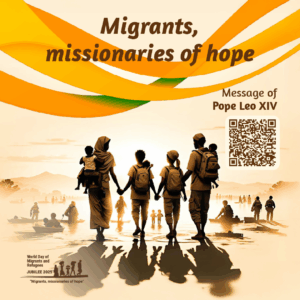
The World Day of Migrants and Refugees (WDMR ), which usually falls on the last Sunday of September, will be celebrated this year on 4 and 5 October on the occasion of the Jubilee of Migrants. The theme of the Pope’s message is “Migrants, Missionaries of Hope”.

In his Message, Pope Leo reflects on the current context “sadly marked by wars, violence, injustice and extreme weather events, which force millions of people to leave their homelands in search of refuge elsewhere”.

The search for happiness is one of the causes of human mobility, and the link between migration and hope, which is well reflected in the Jubilee 2025 motto “Pilgrims of Hope”, is often at the heart of many migration experiences.

As the Pope explains in his Message, it is often migrants, refugees and displaced persons who are “privileged witnesses of hope.  Indeed, they demonstrate this daily through their resilience and trust in God, as they face adversity while seeking a future in which they glimpse that integral human development and happiness are possible”

Pope Leo’s October Prayer Intention “For Collaboration Between Different Religious Traditions”. Intención de oración Papa Leon “Por la colaboración entre las distintas tradiciones religiosas”

This month, Pope Leo XIV invites us to pray “that believers in different religious traditions might work together to defend and promote peace, justice and human fraternity.”

At a time marked by conflicts, the Holy Father recalls that religions must be “bridges and prophecy,” and not “weapons or walls.” His October prayer intention arrives as we celebrate the 60th anniversary of Nostra Aetate, the Declaration from the Vatican II Council that transformed the Catholic Church’s relationships with other religions, opening the path to dialogue and collaboration. In a fractured world, the Pope encourages us to be “yeast of unity,” open to recognize that we are “brothers and sisters, called to live, pray, work, and dream together.”

  • Post your prayer in our sacred space here

Este mes, el papa León XIV nos invita a rezar «para que los creyentes de diferentes tradiciones religiosas trabajen juntos para defender y promover la paz, la justicia y la fraternidad humana».

En una época marcada por los conflictos, el Santo Padre recuerda que las religiones deben ser «puentes y profecía», y no «armas o muros». Su intención de oración para octubre llega cuando celebramos el 60º aniversario de Nostra Aetate, la Declaración del Concilio Vaticano II que transformó las relaciones de la Iglesia católica con otras religiones, abriendo el camino al diálogo y la colaboración. En un mundo fracturado, el Papa nos anima a ser «levadura de unidad», abiertos a reconocer que somos «hermanos y hermanas, llamados a vivir, rezar, trabajar y soñar juntos».

  • Publica tu oración en nuestro espacio sagrado aquí


Position Available: Administrative Assistant

The following position is available in the multi-functional team providing administrative and clerical services to the Congregation of the Sisters of Mercy.

Congregation of the Sisters of Mercy – Community of Work
The incumbent in this position is a valued partner and team member in a shared journey with the Sisters of Mercy. The qualities expected of the Sisters and all those who walk together on this journey are respect for each other, honesty, integrity, trust, confidentiality, hard work, competence, positive attitude, enthusiasm, openness to new ways, flexibility, self-confidence, and loyalty to each other. The employees who work with the Sisters are expected to do their everyday work competently and well, taking pride in their achievements and in the quality of their work.
Summary Statement
This position is an integral member of a multi-functional team by providing administrative and clerical services to the Congregation of the Sisters of Mercy, both as an individual contributor and a team member while supporting the goals and values of the Congregation. The incumbent demonstrates courtesy in all interactions with others and positively contributes to a respectful workplace. The Administrative Assistant works collaboratively with the Leadership and the Finance teams at the Generalate. The Administrative Assistant is expected to work with independent judgement and initiative guided by policies and professional ethics while supporting the goals and values of the
Congregation of the Sisters of Mercy.

Download the full position description (PDF)

Remembering Our Newfoundland Mercy Story 37:
Sister Mary Gonzaga Coady

Esther Mary Joseph Coady, daughter of Mary and John Coady was born in St. John’s in 1835. Our records do not have any information about her before she entered religious life and very little after.

She entered the Sisters of Mercy on August 15, 1858, and at her reception into the novitiate she received the name Sister Mary Gonzaga. She was professed in January of 1861 and in September of that same year, she was named as a member of the founding community of St. Joseph’s Convent, Brigus.

The Catholic population of Brigus had prepared well for the coming of the sisters. They had collected nearly 900 pounds for the construction of the convent. On their arrival at the wharf in Brigus on that September day, the sisters were given a warm and enthusiastic welcome with loud cheering and cannon shots. The excited crowd then led the sisters in procession to their new home.

There had been a Catholic school in Brigus since 1805, operating first out of the home of the teacher, Mr. Robin Power and then in the sacristy of the church. For the first few years after their arrival the sisters taught both boys and girls, but in 1870 a male teacher took over education of the boys. The sisters’ school soon gained a reputation for its high academic record as well as for its excellence in music and drama. The sisters in Brigus also offered a training program for prospective teachers, as noted in the report of the Superintendent of Education in 1902:
“The convent supplies nearly all the teachers employed by the Brigus Board and the excellent training these have received is very evident in the way they conduct their schools.”

Sister M. Gonzaga lived and taught in Brigus for her entire religious life. She died on January 18, 1913, and is buried in the sisters’ cemetery in Brigus.

Esther Mary Joseph Coady, hija de Mary y John Coady, nació en St. John’s en 1835. Nuestros registros no contienen ninguna información sobre ella antes de que ingresara en la vida religiosa y muy poca después.

Ingresó en las Hermanas de la Misericordia el 15 de agosto de 1858 y, al ser admitida en el noviciado, recibió el nombre de sor Mary Gonzaga. Profesó en enero de 1861 y, en septiembre de ese mismo año, fue nombrada miembro de la comunidad fundadora del convento de San José, en Brigus.

La población católica de Brigus se había preparado bien para la llegada de las hermanas. Habían recaudado casi 900 libras para la construcción del convento. A su llegada al muelle de Brigus aquel día de septiembre, las hermanas recibieron una cálida y entusiasta bienvenida con vítores y salvas de cañón. La emocionada multitud acompañó a las hermanas en procesión hasta su nuevo hogar.

Desde 1805 había una escuela católica en Brigus, que primero funcionó en la casa del maestro, el Sr. Robin Power, y luego en la sacristía de la iglesia. Durante los primeros años tras su llegada, las hermanas enseñaban tanto a niños como a niñas, pero en 1870 un maestro se hizo cargo de la educación de los niños. La escuela de las hermanas pronto se ganó una reputación por su alto nivel académico, así como por su excelencia en música y teatro. Las hermanas de Brigus también ofrecían un programa de formación para futuros profesores, como se señala en el informe del Superintendente de Educación de 1902:
«El convento proporciona casi todos los profesores empleados por la Junta de Brigus y la excelente formación que estos han recibido es muy evidente en la forma en que dirigen sus escuelas».

La hermana M. Gonzaga vivió y enseñó en Brigus durante toda su vida religiosa. Murió el 18 de enero de 1913 y está enterrada en el cementerio de las hermanas en Brigus.


Remembering our Newfoundland Mercy Story 36:
Sister M. Catherine Greene

Sister M. Catherine was born in Placentia on February 7, 1879.  Our records do not give her first name, nor the names of her parents. She was educated by the Presentation Sisters in Placentia, where she was also likely prepared for her teaching career.  She spent several years teaching in Harbour Breton before she entered the Sisters of Mercy at St. Joseph’s Convent, Brigus in October of 1911. She made profession of vows on July 1, 1914.

Sister M. Catherine’s teaching career as a Sister of Mercy took her to Burin, St. George’s, Littledale, Petries (Curling), Brigus and Bell Island.  She also ministered at St. Clare’s Working Home for Girls, where she offered evening classes in business education – typing, shorthand and accounting – to the young working women who resided there. The Home closed its doors in early May 1922, and the building was quickly renovated to accommodate a twenty-bed hospital.  When St. Clare’s Mercy Hospital officially opened on May 21, 1922, Sister M. Catherine and Sister M. Gabriel Fleming were assigned to assist the small nursing staff of two nurses – Sister M. Bernard Gladney and Miss Alice Casey.

Following her time at St. Clare’s, Sister M. Catherine went to Curling, where again she taught the commercial classes. When the Curling convent was wired for electricity, evening business classes were made available to the people of the area.  Sister M. Catherine also taught at Immaculate Conception Academy on Bell Island. There she   began the first Business Education program at the Academy, using the convent parlor as her classroom.

In 1937 Sister M. Catherine was assigned to St. Joseph’s where she taught music as well as business courses. She was obviously a woman of many talents and great flexibility and was known for her kind and gentle disposition. She became critically ill in the fall of 1952 and died on August 13, 1953 at the age of seventy-four. She is buried in Belvedere cemetery.

La hermana M. Catherine nació en Placentia el 7 de febrero de 1879. Nuestros registros no indican su nombre de pila ni los nombres de sus padres. Fue educada por las Hermanas de la Presentación en Placentia, donde probablemente también se preparó para su carrera docente. Pasó varios años enseñando en Harbour Breton antes de ingresar en las Hermanas de la Misericordia en el convento de San José, en Brigus, en octubre de 1911. Hizo su profesión de votos el 1 de julio de 1914.

La carrera docente de la hermana M. Catherine como hermana de la Misericordia la llevó a Burin, St. George’s, Littledale, Petries (Curling), Brigus y Bell Island. También ejerció su ministerio en el Hogar de Trabajo para Niñas St. Clare, donde impartía clases nocturnas de formación empresarial (mecanografía, taquigrafía y contabilidad) a las jóvenes trabajadoras que residían allí. El hogar cerró sus puertas a principios de mayo de 1922 y el edificio se renovó rápidamente para albergar un hospital de veinte camas. Cuando el St. Clare’s Mercy Hospital abrió oficialmente sus puertas el 21 de mayo de 1922, la hermana M. Catherine y la hermana M. Gabriel Fleming fueron asignadas para ayudar al pequeño equipo de enfermería, formado por dos enfermeras: la hermana M. Bernard Gladney y la señorita Alice Casey.

Tras su estancia en St. Clare’s, la hermana M. Catherine se trasladó a Curling, donde volvió a impartir clases de comercio. Cuando el convento de Curling se conectó a la red eléctrica, se empezaron a ofrecer clases nocturnas de comercio a los habitantes de la zona. La hermana M. Catherine también enseñó en la Academia Inmaculada Concepción de Bell Island. Allí puso en marcha el primer programa de formación empresarial de la academia, utilizando el salón del convento como aula.

En 1937, la hermana M. Catherine fue destinada a St. Joseph’s, donde impartió clases de música y de comercio. Era evidentemente una mujer con muchos talentos y gran flexibilidad, y era conocida por su carácter amable y gentil. En otoño de 1952 enfermó gravemente y falleció el 13 de agosto de 1953 a la edad de setenta y cuatro años. Está enterrada en el cementerio de Belvedere.

Advocates Say Even Knowing Your Neighbour is a Step Forward for Climate Action

In a recent panel discussion on CBC’s The Signal, climate advocates reacted to the latest climate news, such as this summer’s devastating wildfires in Newfoundland and Labrador and across the country. Sister Mary Tee was a participant in this panel.

‘ “Facts and science knowledge don’t often get to people’s hearts, says Mary Tee, former director of the Mercy Centre for Ecology and Justice.

“There has to be a moral, spiritual way into this because we have to have a change in consciousness, and I don’t think rules and regulations will bring that about,” she said.

“It has to be tapping to our very hearts and our feelings … we’re not just individuals, you know, we’re responsible not just for ourselves, but for our community.”‘

  • Read the complete article here
  • Watch the video of the panel discussion (54:58)

En un reciente debate en el programa The Signal de la CBC, los defensores del clima reaccionaron a las últimas noticias sobre el clima, como los devastadores incendios forestales de este verano en Terranova y Labrador y en todo el país. La hermana Mary Tee participó en este debate.

«Los hechos y los conocimientos científicos no suelen llegar al corazón de la gente», afirma Mary Tee, antigua directora del Mercy Centre for Ecology and Justice.

«Tiene que haber una vía moral y espiritual para abordar esto, porque tenemos que cambiar nuestra conciencia, y no creo que las normas y regulaciones lo consigan», afirmó.

«Tiene que llegar a nuestros corazones y a nuestros sentimientos… No somos solo individuos, sino que somos responsables no solo de nosotros mismos, sino también de nuestra comunidad».

International Day of the World’s Indigenous Peoples

In 1994 the UN General Assembly established August 9 as an annual commemoration of the indigenous populations of the world. This special day of remembrance aims to raise awareness and protect the rights of indigenous peoples and to recognize their contributions to the improvement of world issues, especially environmental protection.

We need indigenous communities for a better world

There are an estimated 476 million Indigenous Peoples in the world living across 90 countries. They make up less than 6 per cent of the world’s population, but account for at least 15 per cent of the poorest. They speak an overwhelming majority of the world’s estimated 7,000 languages and represent 5,000 different cultures.

En 1994, la Asamblea General de las Naciones Unidas estableció el 9 de agosto como día anual de conmemoración de los pueblos indígenas del mundo. Este día especial de recuerdo tiene como objetivo crear conciencia y proteger los derechos de los pueblos indígenas, así como reconocer sus contribuciones a la mejora de los problemas mundiales, especialmente la protección del medio ambiente.

Necesitamos a las comunidades indígenas para un mundo mejor

Se estima que hay 476 millones de pueblos indígenas en el mundo que viven en 90 países. Representan menos del 6 % de la población mundial, pero constituyen al menos el 15 % de los más pobres. Hablan la gran mayoría de las 7000 lenguas que se estiman en el mundo y representan 5000 culturas diferentes.


Remembering our Newfoundland Mercy Story 35:
Sister M. Ignatius Molloy

Alice Molloy, only daughter of Thomas Molloy and Bridget Delaney Molloy, was born in St. John’s on October 7, 1896. We know nothing about Alice’s childhood, except that she had four brothers, one of whom was Edward, Brenda Molloy Mooney’s father. Since the family lived on Patrick Street, it is likely that she received her early education from the Presentation Sisters at St. Patrick’s Convent school.

Alice entered the Sisters of Mercy in St. Georges in 1914 and at her reception into the novitiate in 1915, received the name Sister M. Ignatius. When the amalgamation of all the Mercy convents in Newfoundland took place in 1916, she was transferred to the new General Novitiate at Littledale, where she completed her novitiate and made profession of vows on July 8, 1917.

In 1917 Sister M. Ignatius began her ministry as a professed sister on the staff of St. Clare’s Home for Working Girls. Over the next number of years, her ministry took her to St. Joseph’s Convent in Brigus, to St. Edward’s and Immaculate Conception Convents on Bell Island, to St. Michael’s Convent in St. George’s and to St. Michael’s Convent in Belvedere. In 1922 she went to St. Joseph’s Convent, Hoylestown as a founding member of that community and in September of 1944 she returned to St. Joseph’s as superior.

In all her places of ministry Sister M. Ignatius graciously and generously shared her many talents. She was known to be a gentle, cheerful, competent and kindly classroom teacher and an extremely gifted music teacher.In several schools she taught Commercial as well as the regular subjects.

Although Sister M. Ignatius had been diagnosed in September of 1943 with a serious heart condition, she remained active as superior of St. Joseph’s until her worsening condition obliged her to seek hospital treatment. She died at St. Clare’s Mercy Hospital in January of 1945 at the age of forty-eight. Her mother and her four brothers were present at her funeral liturgy which took place at the Cathedral of St. John the Baptist.

Alice Molloy, única hija de Thomas Molloy y Bridget Delaney Molloy, nació en St. John’s el 7 de octubre de 1896. No sabemos nada sobre la infancia de Alice, salvo que tenía cuatro hermanos, uno de los cuales era Edward, padre de Brenda Molloy Mooney. Dado que la familia vivía en Patrick Street, es probable que recibiera su educación primaria en la escuela del convento de St. Patrick, regida por las Hermanas de la Presentación.

Alice ingresó en las Hermanas de la Misericordia en St. Georges en 1914 y, al ser admitida en el noviciado en 1915, recibió el nombre de hermana M. Ignatius. Cuando se produjo la fusión de todos los conventos de la Misericordia en Terranova en 1916, fue trasladada al nuevo noviciado general en Littledale, donde completó su noviciado y profesó sus votos el 8 de julio de 1917.

En 1917, la hermana M. Ignatius comenzó su ministerio como hermana profesada en el personal del Hogar Santa Clara para chicas trabajadoras. Durante los años siguientes, su ministerio la llevó al convento de San José en Brigus, a los conventos de San Eduardo y de la Inmaculada Concepción en Bell Island, al convento de San Miguel en St. George’s y al convento de San Miguel en Belvedere. En 1922 se trasladó al convento de San José, en Hoylestown, como miembro fundador de esa comunidad, y en septiembre de 1944 regresó a San José como superiora.

En todos los lugares donde ejerció su ministerio, la hermana M. Ignatius compartió con amabilidad y generosidad sus muchos talentos. Era conocida por ser una profesora amable, alegre, competente y bondadosa, además de una profesora de música extremadamente dotada. En varias escuelas impartió clases de Comercio, además de las materias habituales.

Aunque a la hermana M. Ignatius le habían diagnosticado en septiembre de 1943 una grave enfermedad cardíaca, siguió activa como superiora de St. Joseph’s hasta que el empeoramiento de su estado la obligó a buscar tratamiento hospitalario. Murió en el St. Clare’s Mercy Hospital en enero de 1945, a la edad de cuarenta y ocho años. Su madre y sus cuatro hermanos estuvieron presentes en la liturgia fúnebre, que tuvo lugar en la catedral de San Juan Bautista.

Remembering Hiroshima and Nagasaki

It is 80 years since the world’s first atomic bombs were dropped on Hiroshima (6 August) and Nagasaki (9 August).

The Hiroshima Peace Memorial (Atomic Bomb Dome) beautifully framed by lush green trees and manicured hedges, with cloudy skies adding depth to the serene yet reflective scene. This iconic symbol of peace is surrounded by nature, signifying hope and renewal amidst remembrance.

In a message on the occasion of the 80th anniversary of the Hiroshima bombing, Pope Leo XIV urges the international community to renew its commitment to pursue lasting peace for our whole human family.

“Nuclear arms offend our shared humanity and betray the dignity of creation, whose harmony we are called to safeguard” Pope Leo XIV said in a message addressed to Bishop Alexis Shirama of Hiroshima, and read by the Apostolic Nuncio, Archbishop Francisco Escalante Molina during the celebration of Mass for Peace in Hiroshima…

He expressed his respect for the survivors – the hibakusha – whose stories he said, “are a timely summons to all of us to build a safer world and foster a climate of peace.”…

  • Read the complete article here
  • Read the complete message here
  • Post your prayer for peace here


Han pasado 80 años desde que se lanzaron las primeras bombas atómicas del mundo sobre Hiroshima (6 de agosto) y Nagasaki (9 de agosto).

El Monumento a la Paz de Hiroshima (Cúpula de la Bomba Atómica) está bellamente enmarcado por frondosos árboles y setos bien cuidados, con un cielo nublado que añade profundidad a la escena serena y reflexiva. Este icónico símbolo de la paz está rodeado por la naturaleza, lo que significa esperanza y renovación en medio del recuerdo.

En un mensaje con motivo del 80.º aniversario del bombardeo de Hiroshima, el papa León XIV insta a la comunidad internacional a renovar su compromiso de buscar una paz duradera para toda la familia humana.

«Las armas nucleares ofenden nuestra humanidad compartida y traicionan la dignidad de la creación, cuya armonía estamos llamados a salvaguardar», dijo el papa León XIV en un mensaje dirigido al obispo Alexis Shirama de Hiroshima, y leído por el nuncio apostólico, el arzobispo Francisco Escalante Molina, durante la celebración de la misa por la paz en Hiroshima…

Expresó su respeto por los supervivientes —los hibakusha— cuyas historias, según dijo, «son una llamada oportuna a todos nosotros para construir un mundo más seguro y fomentar un clima de paz»…

  • Lea el artículo completo aquí.
  • Lea el mensaje completo aquí. (EN)
  • Publique aquí su oración por la paz.


Pope Leo: Hope is Source of Joy No Matter Our Age

Ahead of the Jubilee Year celebration of World Day for Grandparents and the Elderly—which this year falls on July 27—Pope Leo writes that “hope is a constant source of joy, whatever our age”, adding, “when that hope has also been tempered by fire over the course of a long life, it proves a source of deep happiness.”

In his Message for the Day, Pope Leo offers a scriptural meditation on old age, beginning with biblical figures such as Abraham and Sarah, Zechariah and Elizabeth, as well as Moses, all of whom were called in old age to be part of God’s saving plan.

“The Jubilee we are now celebrating helps us to realize that hope is a constant source of joy, whatever our age.
When that hope has also been tempered by fire over the course of a long life, it proves a source of deep happiness.”

Read the rest of the article here

Read Pope Leo’s message here

Antes de la celebración del Año Jubilar del Día Mundial de los Abuelos y los Ancianos, que este año cae el 27 de julio, el papa León escribe que «la esperanza es una fuente constante de alegría, sea cual sea nuestra edad», y añade: «Cuando esa esperanza también ha sido templada por el fuego a lo largo de una larga vida, resulta ser una fuente de profunda felicidad».

En su mensaje para este día, el papa León ofrece una meditación bíblica sobre la vejez, comenzando con figuras bíblicas como Abraham y Sara, Zacarías y Isabel, así como Moisés, todos los cuales fueron llamados en su vejez a formar parte del plan salvífico de Dios.

«El jubileo que ahora celebramos nos ayuda a darnos cuenta de que la esperanza es una fuente constante de alegría, sea cual sea nuestra edad.
Cuando esa esperanza también ha sido templada por el fuego a lo largo de una larga vida, resulta ser una fuente de profunda felicidad».

Lea el mensaje del Papa León aquí