Sandy Pond, once a pristine, beautiful lake on the Avalon Peninsula of Newfoundland, Canada, now lies within the boundaries of one of Newfoundland and Labrador’s largest industrial sites.
The VALE nickel processing facility is under construction now at Long Harbour, Newfoundland. The Federal Government of Canada has given VALE, and other mining companies, permission to use healthy bodies of Canadian freshwater lakes and ponds as “tailings impoundment areas” for toxic waste. They achieved this because of a loophole, known as Schedule 2, in the Metal Mining Effluent Regulation (MMER) of the federal Fisheries Act.
In March 2010 the Sandy Pond Alliance launched a legal challenge against the Federal Government of Canada to declare Schedule 2 in violation of the federal Fisheries Act.
The Mercy Centre for Ecology and Justice is part of the Sandy Pond Alliance, a coalition of concerned citizens fighting to protect Sandy Pond. The Alliance includes the Council of Canadians, Mining Watch, Nature Canada, the Newfoundland and Labrador Natural History Society, Sierra Club Atlantic, and scientists and activists in Newfoundland who are concerned with the imminent destruction of Sandy Pond.
How It All Began
In May of 2009, the local Chapter of the Council of Canadians organized the Sandy Pond Picnic to bring attention to the issue of the intended destruction of Sandy Pond by the Brazilian mining company Vale Inco as part of their Long Harbour Nickel Processing Plant development. On Friday, May 8, 2009, nearly 20 people visited Long Harbour and trekked into Sandy Pond. After that event several people including activists, academics and community members decided to meet regularly to discuss possible ways to prevent the destruction of Sandy Pond.
Our Mission
1.To protect and conserve Canadian waters and their ecosystems; and
2.To take appropriate actions to assist the Alliance in fulfilling its purpose, including promoting and recommending laws and policies, and informing and engaging the public; and
3.To join and/or co-operate with other organizations or institutions with similar purposes.
Sister Mary Tee RSM, coordinator of the Mercy Centre for Ecology and Justice in St. Johns, Newfoundland serves on the Board of the Sandy Pond Alliance. This Board is still working to save Sandy Pond. In the event that construction on the nickel processing plant may proceed too quickly to save Sandy Pond before a successful ruling on the legal challenge is obtained there is still the hope of saving other bodies of fresh water from a similar fate by changing the law.
Mary Tee rsm recently visited Sandy Pond and was interviewed for “The Current” on CBC radio.
In February and March, 2012 the Sisters of Mercy of Newfoundland marked three major events in the life of the Congregation, the Mercy Sisters in Peru and in the life of three wonderful women, their communities, families and friends.
On February 5 Alita Sanchez Sanchez, from Monsefu renewed her vows as a Sister of Mercy, her third year in preparation for permanent commitment.
On March 1 Maria Elizabeth Galan Fiestas from San Jose on the coast of Peru was received as a postulant in the chapel at the house in Ichocan, Peru. Nine Sisters of Mercy of Newfoundland were present with Maria for her reception as a Postulant, a period of discernment leading to the time of Novitiate.
On March 3, we celebrated the first profession of Rosali Esperaza Vargas Mendoza whose home community is LaGrama in the Andes. These three women are journeying through the various stages of the formation program of new members to full incorporation as Sisters of Mercy. They bring new life and great hope to the Sisters of Mercy, to the church and to the people of Peru. The reception of a postulant and the renewal of vows usually take place in a simple ceremony. The First Profession of Vows is celebrated more publicly and with special ceremony.
Rosali celebrated her First Profession in her home pueblo of LaGrama in company with Sisters, her family and friends. Thirty-five friends travelled to Ichocan, some travelled for two nights by bus from the coast, Lima and northern Peru. Among these were twenty-three sisters of Mercy and our new postulant, Maria, all who minister in various regions of Peru. Others were friends and colleagues of Rosali from Lima, Puerto Eten, Reque and Monsefu where Rosali has ministered. Padre Lucho Santamaria, a longtime friend of our sisters from the coast presided and gave a wonderful homily; he was joined by Padre Walter Cruz, pastor of neighboring San Marcos. All these travelers enjoyed the hospitality and accommodations and then a special meal at our Ichocan sisters` community before going to LaGrama for the Eucharist.
The people of the pueblo and all the guests filled the Church in LaGrama with a spirit of joy and great participation. A delicious meal of cardero (lamb) was prepared by the LaGrama catechists and served with the help of parishioners from Ichocan to over a hundred guests in the lovely adjoining Parish Centre. A classmate of Rosali’s was MC at the lively dance that followed with all forms of dancing. Rosali expressed her joy in making her first profession in these words, “With great joy, I give thanks to God for fixing God`s gaze on me. I celebrate the mercy and fidelity of God expressed together with our pueblo. With profound love, I say ‘Yes’ to this call that allows me to share with joy the Reign of God. Thank you to my family, community, friends and my pueblo for accompanying me on this very special celebration”.
We all rejoice deeply in the treasure of hope and blessing celebrated in the generous commitment of Alita, Maria and Rosali. We ask God’s continued grace in their lives, and in the life of the Sisters of Mercy and of the Church in Peru.
The Sisters of Mercy of Newfoundland and all Sisters of Mercy in Peru rejoice this day!
On March 1, 2012 Maria Elizabeth Galan Fiestas was welcomed into the Postulancy Program, a serious first step in her discernment process and in her incorporation as a Sister of Mercy. The ceremony took place in the newly renovated chapel at the sisters’ residence in Ichocan, Peru. There were nine Sisters of Mercy of Newfoundland present with Maria for this special moment in the life of our Congregation. Sister Elizabeth Marrie, member of the Leadership Team, travelled from St. John’s to be present for this event. Maria will begin the Novitiate phase of her religious formation now in Lima with other women from the Mercy world in Peru.
St. Patrick’s Mercy Home Opens Palliative Care Room
June 20, 2011: St. John’s, NL – St. Patrick’s Mercy Home today announced the official opening of its newly renovated palliative care space during a special Blessing and Celebration Ceremony. The two-year renovation project has been a priority of the Administration and Board of Directors of St. Patrick’s Mercy Home.
The Creedon Family Room is a space dedicated to the needs of a resident in the final stages of life, providing care that is both competent and compassionate. It will also provide a quiet space for family members to be present with their loved one in comfort and convenience.
“It is a privilege to be a part of this dedication,” said Joan Marie Aylward, Executive Director, St. Patrick’s Mercy Home. “This room will be a beautiful enhancement to the lives of families and residents at such an important time.”
The room is named in memory of Sister Francis Creedon, founder of the Sisters of Mercy in Newfoundland. Sister Francis came to St. John’s with two other companions from Dublin, Ireland on June 3, 1842 and established the first Mercy foundation in the New World. Sister Francis visited the homes of the sick and dying of St. John’s and cared for victims of the cholera epidemic which occurred in 1854.
”The Sisters of Mercy have been committed to special space for palliative care services since they first established the Palliative Care Unit at St. Clare’s Mercy Hospital in 1979,” said Sr. Elizabeth Davis, Congregational Leader for the Sisters of Mercy. “We are delighted that St. Patrick’s Mercy Home has now found dedicated space for palliative care to continue the strong support the staff and volunteers have always given to dying residents and their families. May all residents who die in this space know dignity and peace as they spend their last days on this earth here with their loved ones.”
St. Patrick’s Mercy Home Foundation provided the funding for the furnishing of the room. A generous bequest was also made on behalf of Mary and Helen Flynn, two former residents of St. Patrick’s.
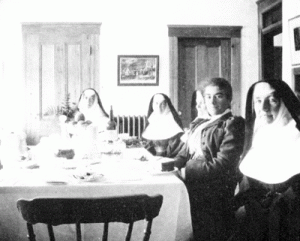
On Friday, July 28, 1893, the SS Harlow docked in Sandy Point on Newfoundland’s west coast. On board were Bishop Michael Francis Howley, Vicar Apostolic of St. George’s, four Sisters of Mercy from Providence, Rhode Island – Sisters Mary Antonio Egan, Mary Corsini Dempsey, Mary Veronica Payne, Mary Sylvester Carver – and Mrs. Henrietta Brownell, their friend and sponsor. Bishop Howley must have been beaming with delight as he escorted his missionary band down the gangplank to the crowds of people waiting on the dock. His dream and that of his predecessors was finally being realized. The west coast of Newfoundland had its first community of nuns.
Sisters with Mrs Brownell
The Evening Telegram of August 13, 1893 describes in glowing terms their arrival at “the beautiful and picturesque settlement of Sandy Point”. An excited and enthusiastic crowd, salvoes of guns, arches, wreaths and flags and addresses of salutation made the event lively, colourful and welcoming. This was obviously an occasion of great joy, anticipation and celebration for the people of Sandy Point.
What must the new Mercy community have been feeling as they landed in this strange, new place? The excitement of a new venture – most likely; the sense of being welcomed into people’s hearts – surely; the shiver of anxiety in the face of the unknown – perhaps; the shock of reality as they looked around them – likely.
Though Sandy Point was at this time a bustling port, it lacked any of the amenities to which the sisters had been accustomed in Providence, Rhode Island. The political and economic difficulties associated with the French Shore kept this area largely undeveloped until the early part of the twentieth century. When the sisters had time to look around, they would have seen rough paths instead of roads, crude shelters for most of the homes and many other signs of poverty and neglect. But they did not seem to be dismayed, and from the very beginning they set about meeting the people, visiting the sick and preparing for the opening of school. They had come to help effect change, and they kept looking forward, seeing what could be done and taking steps, however small, towards making it happen.
The school at Sandy Point was small and roughly built, vastly different from the stately, well-equipped academies the sisters had left behind in Rhode Island.
When school opened in September, about fifty children came, most of whom were poorly fed and poorly clad, and lacking in any basic knowledge of the faith.
From the beginning there was a language barrier that made instruction difficult on both sides – the sisters’ strange accent and the patois used by the children.
What must it have been like for these sisters to try to cultivate a love of learning in children who were hungry, tired and listless? Can we imagine what they were faced with as they trudged through mud-paths, braving the sharp winds of Bay St. George to visit the sick and poor in their homes? Did they ever long for the conveniences they once took for granted – things that would make life so much easier.
This new set of circumstances in which the sisters now found themselves must have called forth from each of them great compassion, generous flexibility, a keen sense of humour and a deep commitment to the call to mission. What stories they must have shared as they gathered at nightfall in the lamplight – or were they too tired to share at all? Did the glorious sunsets so characteristic of the West, lift their hearts? What were their thoughts as they watched the ebb and flow of the tides on the Sandy Point sandspit? Did they speak to one another about who and what they missed, what they loved, what they hoped for, what they feared …
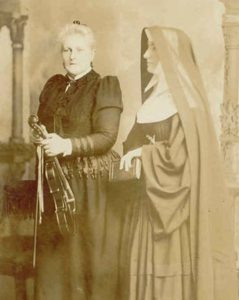
Henrietta Brownell and Sr Antonio
The leader of this pioneer missionary group was Sister Mary Antonio Egan, a woman of culture and refinement and an excellent educator, described in the Annals of St. George’s as “one of the ablest teachers in the country.” As early as April of 1894, the convent school treated the people of Sandy Point to a concert, which The Evening Telegram described as being “of superior quality” and in which the musical portion of the program was managed by Mrs. Brownell. Indeed because of the sisters’ concern for an all-round education for the children and the generous sharing of Mrs. Brownell’s musical abilities, music became the hallmark of the convent school.
In 1899, with the coming of the railway the Sisters moved to St. George’s, and the new St. Michael’s Academy opened. Under the wise and efficient leadership of Sister Mary Antonio and her competent and dedicated staff, the school flourished, and before long St. Michael’s became known for its broad-based curriculum and innovative teaching practices. In 1900 St. Michael’s welcomed its first two resident students, and the fledgling community also began to attract new members. Drawn to the flame of Mercy, these young women brought generous hearts and ready hands to expand and enrich the mission entrusted to the pioneer sisters.
The story of the St. George’ s foundation is the story of courageous women, women grounded in faith, steeped in a sense of mission, committed to bringing about God’s reign wherever and however they could, all the while strengthened by the mission itself and by the love and support of the people they had come to serve. This, of course, did not mean that the difficulties of daily life in their new homeland did not affect them, discourage them at times or cause them to question their choices. They were human and, like us, had to deal with life as it unfolded each day, both with its predictabilities and its surprises. Sister Mary Antonio and her sisters have left us a rich heritage, a heritage shaped by vision, passion, compassion and dedication. We are immeasurably blessed by the life and ministry of these great women of Mercy, who illuminate the pages of our Mercy story.
by Charlotte Fitzpatrick,rsm
El viernes 28 de julio de 1893, el SS Harlow atracó en Sandy Point, en la costa oeste de Terranova. A bordo iban el Obispo Michael Francis Howley, Vicario Apostólico de St. George’s, cuatro Hermanas de la Misericordia de Providence, Rhode Island – las Hermanas Mary Antonio Egan, Mary Corsini Dempsey, Mary Veronica Payne, Mary Sylvester Carver – y la Sra. Henrietta Brownell, su amiga y madrina. El obispo Howley debía de estar radiante de alegría mientras escoltaba a su banda misionera por la pasarela hasta la multitud que esperaba en el muelle. Su sueño y el de sus predecesores por fin se estaba haciendo realidad. La costa oeste de Terranova tenía su primera comunidad de monjas.
El Evening Telegram del 13 de agosto de 1893 describe en términos elogiosos su llegada al “hermoso y pintoresco asentamiento de Sandy Point”. Una multitud excitada y entusiasta, salvas de cañones, arcos, coronas y banderas y discursos de saludo hicieron que el acontecimiento fuera animado, colorido y acogedor. Evidentemente, fue una ocasión de gran alegría, expectación y celebración para los habitantes de Sandy Point.
¿Qué debió de sentir la nueva comunidad de la Misericordia al aterrizar en este extraño y nuevo lugar? La emoción de una nueva aventura, seguramente; la sensación de ser acogidos en el corazón de la gente, seguramente; un escalofrío de ansiedad ante lo desconocido, tal vez; la conmoción de la realidad al mirar a su alrededor, probablemente.
Aunque Sandy Point era entonces un puerto bullicioso, carecía de todas las comodidades a las que las hermanas estaban acostumbradas en Providence, Rhode Island. Las dificultades políticas y económicas asociadas a la Costa Francesa mantuvieron esta zona en gran parte sin desarrollar hasta principios del siglo XX. Cuando las hermanas tuvieron tiempo de mirar a su alrededor, habrían visto senderos escabrosos en lugar de carreteras, toscos refugios para la mayoría de los hogares y muchos otros signos de pobreza y abandono. Pero no se amilanaron y desde el principio se dedicaron a conocer a la gente, visitar a los enfermos y preparar la apertura de la escuela. Habían venido para contribuir al cambio y seguían mirando hacia delante, viendo lo que se podía hacer y dando pasos, por pequeños que fueran, para conseguirlo.
La escuela de Sandy Point era pequeña y de construcción tosca, muy diferente de las majestuosas y bien equipadas academias que las hermanas habían dejado atrás en Rhode Island.
Cuando la escuela abrió sus puertas en septiembre, acudieron unos cincuenta niños, la mayoría mal alimentados y mal vestidos, y carentes de cualquier conocimiento básico de la fe.
Desde el principio hubo una barrera lingüística que dificultaba la instrucción por ambas partes: el extraño acento de las hermanas y el patois utilizado por los niños.
¿Cómo debió de ser para estas hermanas intentar cultivar el amor por el aprendizaje en niños hambrientos, cansados y apáticos? ¿Podemos imaginar a qué se enfrentaban cuando caminaban por senderos de barro, desafiando los fuertes vientos de la bahía de San Jorge, para visitar a los enfermos y a los pobres en sus casas? ¿Alguna vez anhelaron las comodidades que antes daban por sentadas, cosas que les harían la vida mucho más fácil?
Las nuevas circunstancias en las que se encontraban las hermanas debieron de suscitar en cada una de ellas una gran compasión, una generosa flexibilidad, un agudo sentido del humor y un profundo compromiso con la llamada a la misión. ¿Qué historias habrán compartido cuando se reunían al anochecer a la luz de la lámpara, o estaban demasiado cansadas para compartirlas? ¿Las gloriosas puestas de sol, tan características del Oeste, elevaban sus corazones? ¿Qué pensaban mientras observaban el flujo y reflujo de las mareas en el arenal de Sandy Point? ¿Hablaron de lo que echaban de menos, de lo que amaban, de lo que esperaban, de lo que temían?…
La líder de este grupo misionero pionero era la hermana Mary Antonio Egan, una mujer de cultura y refinamiento y una excelente educadora, descrita en los Annals of St. George’s como “una de las profesoras más hábiles del país”. Ya en abril de 1894, el colegio del convento obsequió a los habitantes de Sandy Point con un concierto, que El Evening Telegram describió como “de calidad superior” y en el que la parte musical del programa fue dirigida por la señora Brownell. De hecho, gracias a la preocupación de las hermanas por la educación integral de los niños y a la generosa aportación de las habilidades musicales de la Sra. Brownell, la música se convirtió en el sello distintivo de la escuela del convento.
En 1899, con la llegada del ferrocarril, las hermanas se trasladaron a St. George’s, y se abrió la nueva Academia de St. Bajo la sabia y eficiente dirección de la hermana Mary Antonio y su competente y dedicado personal, la escuela floreció, y en poco tiempo St. Michael’s se hizo famosa por su amplio plan de estudios y sus innovadoras prácticas docentes. En 1900 St. Michael dio la bienvenida a sus dos primeras estudiantes residentes, y la incipiente comunidad también comenzó a atraer a nuevos miembros. Atraídas por la llama de la Misericordia, estas jóvenes aportaron corazones generosos y manos dispuestas a ampliar y enriquecer la misión confiada a las hermanas pioneras.
La historia de la fundación de San Jorge es la historia de mujeres valientes, mujeres cimentadas en la fe, impregnadas de un sentido de la misión, comprometidas a llevar el reino de Dios dondequiera y comoquiera que pudieran, siempre fortalecidas por la propia misión y por el amor y el apoyo de la gente a la que habían venido a servir. Esto, por supuesto, no significaba que las dificultades de la vida cotidiana en su nueva patria no les afectaran, les desanimaran a veces o les hicieran cuestionarse sus decisiones. Eran humanas y, como nosotros, tenían que enfrentarse a la vida tal y como se desarrollaba cada día, tanto con sus previsiones como con sus sorpresas. La Hermana Mary Antonio y sus hermanas nos han dejado una rica herencia, una herencia forjada por la visión, la pasión, la compasión y la dedicación. Somos inconmensurablemente bendecidas por la vida y el ministerio de estas grandes mujeres de la Misericordia, que iluminan las páginas de nuestra historia de la Misericordia.
On June 9, 2011 the newly-renovated chapel of St. Clare’s Mercy Hospital was re-opened following closure for renovations. The event was set within a context of praise and gratitude and was attended by many guests, staff and volunteers at the hospital.
Following a welcome by Sister Diane Smyth, manager of pastoral care and ethics, there was a short overview of the history of the chapel. The reading chosen for the occasion was taken from Revelation 21:1-3. The assembly responded with the singing of Psalm 84 “How lovely is Your dwelling place, O Lord of Hosts.” Sister Elizabeth Davis, Congregational Leader, gave a beautiful reflection on the sacredness of space, noting how the chapel at St. Clare’s has been such a source of blessing over the past sixty years. Since the chapel is dedicated to Our Lady of Mercy, the soloist gave a lovely rendition of Schubert’s ‘Ave Maria’. A reception followed during which guests, staff and volunteers could reminisce and simply marvel at the beauty of the place.
The original chapel opened in 1950. Unique features of it are 14 beautiful stained glass windows designed by Earley, Dublin, marble sanctuary, altar, tabernacle and altar rail, all donations from various individuals of the area.
St. Clare’s community is pleased to see the chapel in use again. May it continue to be a place of blessing for all, a place of worship, solitude, reflection and prayer.
On June 3, 1842 a sailing schooner, the Sir Walter Scott, entered the harbour of St. John’s, Newfoundland. On the wharf were Bishop Michael Anthony Fleming and many townspeople excited to welcome three Sisters of Mercy who were to establish the first foundation of the Mercy Order in the “new world.” The three women from Baggot Street had left Kingstown Harbour on May 2 for the difficult and dangerous crossing of the north Atlantic. Who were these three courageous Sisters of Mercy? They were Sisters Ursula Frayne, Rose Lynch and Francis Creedon.
This is part of the story of that foundation and of Sister Francis Creedon who is upheld by the Newfoundland Sisters of Mercy of Newfoundland as founder.
This year 2011 marks the 200th anniversary of Marianne Creedon’s birth in Coolowen, County Cork. Sr. Charlotte Fitzpatrick has provided us with this reflection on Francis Creedon in honour of this anniversary. (June 2011)
Reflection on Sister Mary Francis Creedon
Foundress of the Sisters of Mercy of Newfoundland, on the 200th anniversary of her birth
Two hundred years ago this year in County Cork, Ireland, Marianne Creedon, known to us as Sister Francis Creedon, was born. We know little about Marianne’s early life, but we do know that her adult life was one of service and unwavering fidelity in the face of seemingly insurmountable obstacles.
Marianne’s call to Mercy came through a circuitous route. She left her native Ireland just a couple of years after the foundation of the Sisters of Mercy, and it is likely that she was not even aware of this event that was to impact her life so significantly. Arriving in St. John’s with her sister’s family, the Nugents, in 1833, she dedicated herself to caring for the four Nugent children and helped support the family by teaching music. Her own experience of life in St. John’s and her conversations with Bishop Fleming, a long-time friend of the Nugent family, opened her eyes to the deep gaps in Catholic education and to the sad plight of the sick poor in her adopted homeland.
The bishop was determined to find a community of nuns who would be able to respond to these very urgent needs of his people. Hearing of the great work being done by the newly-established Order of Mercy in Ireland and learning that they were not bound by the customary law of enclosure, he saw these sisters as ideally suited to his plans. He undoubtedly shared his hopes and his excitement with Marianne, who must have been moved by the bishop’s zeal as well as by what she saw around her.
While we do not know the details or the sequence of what happened next, we know that Bishop Fleming met with Catherine McAuley, shared his dream with her and received a favourable response from her. We also know that Marianne Creedon, attentive to God’s ways in her life, expressed her desire and availability for this mission to the people of Newfoundland.
In 1839 Marianne left for Dublin to make her novitiate with Catherine McAuley, with the express purpose of establishing the Order of Mercy in Newfoundland. Professed in 1841, she was ready for her mission, but the foundation plans were delayed because of Catherine’s death in November of that year. This delay must have been a disappointment for the newly-professed Sister Mary Francis, but she remained steadfast and continued ministry at Baggot Street until May of 1842.
What sort of woman was Sister Mary Francis Creedon? Sisters who lived with her at Baggot Street spoke of her as an exemplary religious, loved and revered by all who knew her. They described her as sensitive and cultured, zealous and thoroughly unselfish. One sister referred to her “large-hearted friendship which was a blessing and support to those who enjoyed it.” Another related that she was always happy to be appointed to visit the sick and perform other duties with Sister Mary Francis. From these recollections of her peers, preserved for us in Volume 111 of the Leaves of the Annals of the Sisters of Mercy, we get a glimpse of a very human, faith-filled, unassuming woman, gifted with the qualities of personality and spirit that enabled her to forge the beginnings of Mercy life and ministry in Newfoundland.
However, it was her thirteen years as a Sister of Mercy in nineteenth-century St. John’s that tell us so much more about this steadfast woman, whom we are privileged to call our Newfoundland founder. Of the three pioneer sisters who arrived in St. John’s on June 3, 1842, only Sister M. Francis would have known what she was coming to. Although she would have the joy of being reunited with her family and friends, she also knew firsthand some of the difficulties the new community would have to face – the isolation and loneliness ; the rigors of the Newfoundland climate; the flimsy, crowded tenements they would visit regularly; the poverty and disease that would daily surround them. But not even she could have forseen some of the tensions, obstacles and sufferings that would be part of this new venture and that would test the very foundations of her call and the mission of Mercy, to which she had committed her life. Among these were:
The pain of being caught in the middle between Bishop Fleming, her friend and Sister Ursula Frayne, the named superior of her community
The conflict in community surrounding the acceptance of Sister Joseph Nugent, her brother-in-law’s sister
The return to Ireland of Sisters Ursula and Rose just six months after their first school opened
The unwillingness of the Baggot Street sisters to send help to the fledgling foundation
The devastation of the Great Fire of 1846
The typhus epidemic of 1847 and the constant call of the sick for help and consolation
The death of Sister Joseph Nugent in June 1847, leaving her to carry on alone
The loneliness, isolation and concerns of the following year when she kept school open, taught music and visited the sick
The death of her friend and mentor, Bishop Fleming in 1850
The cholera epidemic of 1854 which left many children orphaned, and which led to the establishment of the Immaculate Conception Orphanage at Mercy Convent
Her “wearing out” at the age of 43 years
In the midst of all this seeming turmoil and suffering, what made Sister Francis stay? She was urged by many of her friends to give up the mission. Mother Agnes O’Connor, her friend from novitiate days, invited her to join her in New York. Yet she stayed …
What soul-searching went on in her?
How did she perceive God’s action in all of this pain and uncertainty?
What sustained her at these times?
What helps you to remain faithful when all seems confusing, uncertain, hopeless …?
Sister M. Francis Creedon was undoubtedly a woman of profound faith, of indomitable courage and determination, a woman who trusted in the God Who had called her, a woman convinced of the action of God in her life and in the mission entrusted to her. She likely had her doubts, fears, questions, her times of wondering what God was doing, but the urgency of the mission impelled her, keeping her available, pliable, compassionate and hopeful in situations where hope seemed frail, sometimes even futile. In some of those dark times, she likely would have called to mind some of Catherine’s teachings while she was a novice at Baggot Street, taking comfort in their message.
Had Catherine not said that new foundations would not be without the cross, that the congregation was founded on Calvary to serve a crucified Redeemer?
Had Catherine not spoken often and passionately about the comfort of God’s providential care, of the joy of a life centered in God, of the necessity of placing one’s trust in God alone?
In her times of solitude, memories such as these must have surfaced in Sister Francis, bringing her hope and consolation, strengthening her for the incredible journey of faith she was living. Many times as she prayed at Mercy Convent, she must have fingered her beads, reliving the joyful, sorrowful and glorious mysteries of her own life, thanking God for the gift of her call to Mercy, believing that all was in God’s hands, and that the fruit of her labours would come in God’s own time. Her call, her life, her ministry of Mercy is a gift to us, a treasure to be claimed and cherished as we remember and celebrate her on June 3 this year.
As you reflect on Francis’ life, what stands out for you?
What gift is she giving you today?
What gift of Mercy will you pass on to others?
The Roads of Mercy
(Mary Wickham, RSM)
The roads of Mercy are long and deep,
wondrous wise and never-ending.
The roads of Mercy are questing tracks of the Spirit;
On Sunday afternoon, February 13, 2011 Mercy Convent Chapel was the setting for a rich experience of how God continues to grace our Mercy Congregation. Pews and Prie-Dieu were filled to capacity with Sisters, Associates and family members, gathered to welcome new Associates into the Mercy Associate Relationship. In a beautiful Prayer/Ritual led by their facilitators, Sisters Margie Taylor and Madeline Byrne, three women – Mickie Pitcher, Marilyn Stack and Geraldine (Gerri) Stapleton made their commitment as Mercy Associates
Sister Elizabeth Davis, Congregation Leader, welcomed the new Associates, received their commitments and presented them with their Associate pins and Certificates. Husbands and other family members were present to participate in the ceremony and share in the joy of their loved ones as they entered upon another significant phase in their spiritual journey.
The sentiments of all Associates present were echoed in the words of Associate, Anna Kelly in her reflection, “What Being a Mercy Associate Means to Me.” Anna spoke of their Associate meetings as “ time for prayer, sharing, showing support and concern for each other, having time to develop new friendships and of course, enjoying a story and a few laughs as they share that ‘comfortable cup of tea’ at the end of the meeting.” She noted that each Associate brings to the group their own gifts and talents that enable them to companion with the Sisters of Mercy to carry on Catherine McAuley’s charism, to bring the Mercy of God to those in need. At the same time, Associates deepen their own Baptismal commitment to live more fully the values of the Gospel.
A spirit of joy and gratitude flowed from the chapel to the Fleming Room where friendship and fun were shared over the rim of that traditional tea cup!
On September 29, 2010 Feast of the Archangels Michael. Raphael and Gabriel and birthday of Venerable Catherine McAuley, Padre Victor was buried in the garden of his parish church in Reque, Peru.
Three days earlier, after weeks of serious illness and hospitalization, Padre Victor made his final life’s journey surrounded by loving prayer, song and attentiveness, hope and patient waiting of his people. Victor was much loved. He dedicated his life to being the padre to his parishioners and their families. He loved his life, his faith and his church and his God. He lived the joy of the gospel and stood strong in the face of injustice- he was fierce advocate for his people and cared not only for their souls but also for their dignity and rights. Padre Victor was a strong man yet sickness was stronger and defeated him, in body, but not in spirit nor in the legacy that he leaves to those who knew him. Padre Victor will not be forgotten.
Padres Emigido and Lucho have shared so much of life with Victor from their young days. The three were lovingling known as the three amigos. In speaking of Victor throughout the days before the funeral they stressed over and over his gift of love of life, his “Alegria” which he passed on to all, his total dedication to the people especially the “más pobres”, his untireless service not only to his parish, but nationally, to the whole diocese. There was lots of great singing led by Reque Parish choir, lots of clapping in the midst of the reflection, etc.
The funeral was an especially blessed moment. There were crowds in the thousands in the plaza where the funeral took place. The altar was set in the door of the church facing the plaza. The Bishop officiated with fifty-two priests attending. Among the priests were Eugene Roy from Ontario and Jose Alverez Calderon, a great liberation Theologian based in Lima. There was extensive lay participation in the Mass
After Mass, the body of Padre Victor was brought in procession around the plaza with a special ceremony in front of the Municipal building. His body was then taken to the garden in front of the church where Victor is now buried. There is a small plaque marking his burial place, but a bigger monument is being planned for. Words used to describe Victor were “the saint of Reque,” “our joyful, happy saint in heaven,” and “the alma (spirit) of catechesis familiar.”
Victor was known and loved by many Sisters of Mercy of Newfoundland and by some of the priests who worked with him in Peru. He is sorely missed.
Tu nos has muerto; viveras en nuestros corozones y te recordaremos
The official blessing of the Mercy Centre for Ecology and Justice located in the lovely Pippy Park area of St. John’s took place today.
Sister Elizabeth Davis spoke to the more than fifty people in attendance; she moved throughout the Centre with a prayer of blessing being chanted by a small choir and the quests. Sister Mary Tee is the coordinator of the Centre and was host of today’s events. Light refreshments were served.
The building is a bungalow that was renovated to provide office and meeting space for the Centre’s activities. It is situated on an acre of land that has fruit trees and berry bushes around the perimeter and fertile soil that has seen two crops of vegetables in the past two summers. The garden is a project of the Centre in collabloration with a group of “new Canadians” and students of St. Bonaventure’s College. The produce is shared with the food banks and other groups. Many educational and reflective opportunities are provided through the Centre.




 tude, reflection and prayer.


 On September 29, 2010 Feast of the Archangels Michael. Raphael and Gabriel and birthday of Venerable Catherine McAuley, Padre Victor was buried in the garden of his parish church in Reque, Peru.
  The official blessing of the Mercy Centre for Ecology and Justice located in the lovely Pippy Park area of St. John’s took place today.